Members LoginJoin TCG

Trusted Knowledge, Openly Shared

View all resources

Blogs

Trends, technical deep dives, case studies and interviews from across the trusted computing community.

Documents

Searchable by technology and Work Group, with planned ISO/NIST tagging for compliance mapping.

Educational Content

Free courses and hands-on labs covering TPM, cryptography basics, TSS and attestation.

Events & Webinars

Conferences, webinars and Plugfests where the trusted computing community meets.

Github

Reference code, tools and implementations maintained by TCG and its Work Groups.

Guides & White Papers

Use-case explainers, best practices and executive summaries organised by vertical.

Public Review

Draft TCG specifications open for public comment before publication, and how to take part.

View all resources

Our Core Technologies & Standards

View all Technologies

Block Integrated Trust (BIT)

Brings trusted computing principles to block-level storage, enabling integrity, attestation, and protection of data blocks at the device layer.

Cyber Resilient Technologies (CyRes)

TCG's cyber-resilience technology for protecting persistent code, detecting unexpected states, and recovering platforms to a known trusted state.

Device Identifier Composition Engine (DICE)

Device Identifier Composition Engine establishes a unique cryptographic identity for resource-constrained devices and IoT systems with minimal hardware.

Platform Certificates

TCG's provenance artifacts asserting Roots of Trust, Trusted Building Blocks, and component composition for supply-chain assurance and attestation appraisal.

Reference Integrity Manifest (RIM)

Signed, machine-readable reference measurements used to verify a device boots and runs in its expected, trusted state.

Storage Security

TCG's architecture for interoperable security on trusted storage devices: self-encrypting drives, access control, locking, and Opal, Ruby, and Opalite classes.

TPM Software Stack (TSS)

A consistent software interface that lets applications and operating systems interact with TPM hardware across vendors, architectures, and platforms.

Trusted Platform Module (TPM)

Hardware-based root of trust that securely generates and stores cryptographic keys, attesting to the integrity of the platform it runs on.

View all Technologies

Where Experts Drive the Standards

View all Work Groups

Aerospace and Non-Terrestrial Systems Solutions

Attestation

Block Integrated Trust (BIT)

Cyber Resilient Technologies (CyRes)

Device Identifier Composition Engine (DICE)

Greater China

Infrastructure

Internet Of Things (IoT)

Japan

Mobile

Network Equipment

PC Client

Server

Storage

TPM Software Stack (TSS)

Trusted Platform Module (TPM)

Vehicle Services

Virtualized Platform

View all Work Groups

Securing Every Sector, Together

View all industries

Aerospace

Agriculture & Construction

Automotive

Education & Government

Energy & Smart Grid

Finance

Healthcare

Insurance

Manufacturing & Industrial Control

Media & Entertainment

Real Estate & Hospitality

Retail, Logistics & Transportation

Telecommunications

View all industries

Built by the Industry, for the Industry

Join TCG

About us

Learn who we are, how our standards are built, and the people and Work Groups shaping trusted computing worldwide.

Contact

Questions about membership, certification or our specifications? Get in touch with the right team.

Events

Conferences, webinars and Plugfests where the trusted computing community meets.

News

Announcements, specification releases and updates from TCG and its members.

Vulnerability Disclosure Policy

How to report vulnerabilities in TCG specifications and how TCG handles and discloses them.

Join TCG

Be Part of What's Next

Join TCG

Become a Member

Compare membership levels and find the one that matches how much you want to shape the standards.

Certifications

Certify your TPM, storage or network product against TCG compliance and security requirements.

Member Login

Access the member workspace, Work Group drafts and specifications in progress.

Member News

Product launches, milestones and announcements from across the TCG membership.

TCG Members

The companies, research institutions, government agencies and standards bodies building trusted computing together.

Join TCG

Become part of TCG

Join now
Resources/
Guides & White Papers

Trusted Platform Module (TPM) Summary

White Paper

Tap to preview
Latest version

Trusted Platform Module Summary_04292008

Last updated:Apr 1, 2008
Apr 1, 2008
3 pages
212 KB
Download

TPM (Trusted Platform Module) is a computer chip (microcontroller) that can securely store artifacts used to authenticate the platform (your PC or laptop).

TPM (Trusted Platform Module) is a computer chip (microcontroller) that can securely store artifacts used to authenticate the platform (your PC or laptop). These artifacts can include passwords, certificates, or encryption keys. A TPM can also be used to store platform measurements that help ensure that the platform remains trustworthy. Authentication (ensuring that the platform can prove that it is what it claims to be) and attestation (a process helping to prove that a platform is trustworthy and has not been breached) are necessary steps to ensure safer computing in all environments.

Trusted modules can be used in computing devices other than PCs, such as mobile phones or network equipment.

Picture 1: Components of a TPM
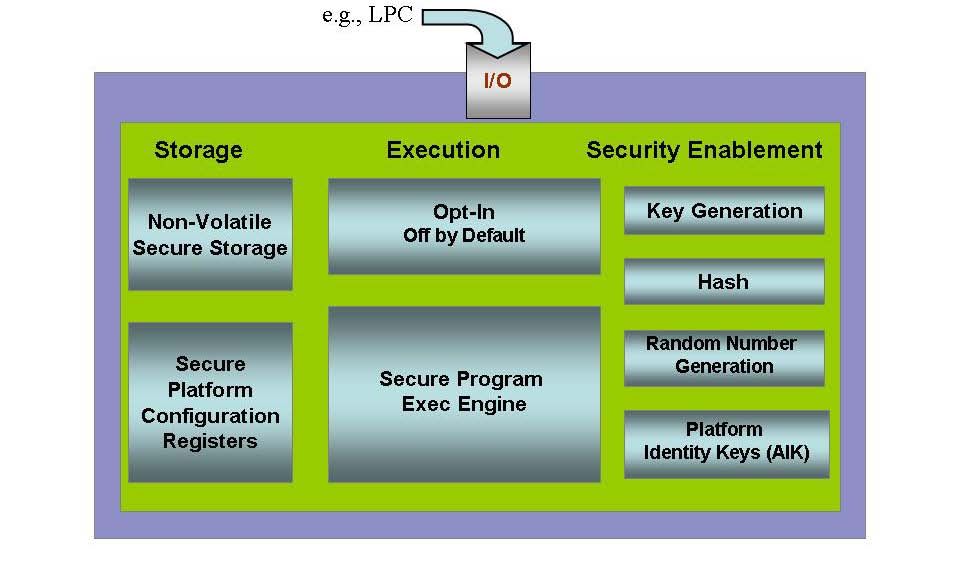
The nature of hardware-based cryptography ensures that the information stored in hardware is better protected from external software attacks. A variety of applications storing secrets on a TPM can be developed. These applications make it much harder to access information on computing devices without proper authorization (e.g., if the device was stolen). If the configuration of the platform has changed as a result of unauthorized activities, access to data and secrets can be denied and sealed off using these applications.

However, it is important to understand that TPM cannot control the software that is running on a PC. TPM can store pre-run time configuration parameters, but it is other applications that determine and implement policies associated with this information. Processes that need to secure secrets, such as digital signing, can be made more secure with a TPM. And mission critical applications requiring greater security, such as secure email or secure document management, can offer a greater level of protection when using a TPM. For example, if at boot time it is determined that a PC is not trustworthy because of unexpected changes in configuration, access to highly secure applications can be blocked until the issue is remedied (if a policy has been set up that requires such action). With a TPM, one can be more certain that artifacts necessary to sign secure email messages have not been affected by software attacks. And, with the use of remote attestation, other platforms in the trusted network can make a determination, to which extent they can trust information from another PC. Attestation or any other TPM functions do not transmit personal information of the user of the platform.

These capabilities can improve security in many areas of computing, including e-commerce, citizen-to-government applications, online banking, confidential government communications and many other fields where greater security is required. Hardware-based security can improve protection for VPN, wireless networks, file encryption (as in Microsoft's BitLocker) and password/PIN/credentials' management. TPM specification is OS-agnostic, and software stacks exist for several Operating Systems.

TPMs (current version is 1.2) use the following cryptographic algorithms: RSA, SHA1, and HMAC.

The Trusted Computing Group (TCG) is an international de facto standards body of approximately 120 companies engaged in creating specifications that define PC TPMs, trusted modules for other devices, trusted infrastructure requirements, APIs and protocols necessary to operate a trusted environment. After specifications are completed, they are released to the technology community and can be downloaded from the TCG Web Site.

Without standard security procedures and shared specifications, it is not possible for components of the trusted environment to interoperate, and trusted computing applications cannot be implemented to work on all platforms. A proprietary solution cannot ensure global interoperability and is not capable of providing a comparable level of assurance due to more limited access to cryptographic and security expertise and reduced availability for a rigorous review process. From the point of view of cryptography, for interoperability with the other elements of the platform, other platforms, and infrastructure, it is necessary for trusted modules to be able to use the same cryptographic algorithms, Although standard published algorithms may have weaknesses, these algorithms are thoroughly tested and are gradually replaced or improved when vulnerabilities are discovered. This is not true in the case of proprietary algorithms.

According to market research reports, over 100 million branded PCs and laptops with TPMs were sold in 2007. Server produces are beginning to ship, and a variety of applications based on TPM, such as secure email or file encryption, have been implemented using TCG specifications. Trusted Network Connect (TNC) products that use TCG principles to enhance the security of communications are shipping, too. Draft specifications for storage (for hard drives) and mobile trusted modules (for mobile telephones) have been released.

White Paper Available for Download: Trusted Platfrom Module (TPM) Summary

Published by Work Group
Trusted Platform Module (TPM)

Explore other guides & white papers

View all

Guide

Trusted Platform Module 2.0: A Brief Introduction

The Trusted Computing Group (TCG) has been addressing the trust issue and related security benefits  for PCs, servers, networking gear and embedded systems…
Work Group

Trusted Platform Module (TPM)

Last updated

Mar 7, 2018

White Paper

Implementing Hardware Roots of Trust

SANS Institute has developed a first-of-its-kind guide and informational webcast to update organizations on exciting new uses for implementing hardware roots…
Work Group

Storage

Trusted Platform Module (TPM)

Last updated

Jun 1, 2013

White Paper

SHA-1 Uses in TPM v1.2

This document catalogs the usages of SHA-1 in the TPM v1.2 specifications and assesses the impact of the collision attacks discovered in 2005 against them. In…
Work Group

Trusted Platform Module (TPM)

Last updated

Jan 1, 2011

Become part of TCG

Membership is open to corporations, start‑ups, government, academia, and non‑profits. Join to influence specs in Work Groups, access drafts, network with experts, and submit products for TCG Certification.

Compare Membership Levels

Shape the future of trusted computing: collaborate on the development of open standards and accelerate their adoption.

trusted computing group

3855 SW 153rd Drive, Beaverton, Oregon 97003, USA

+1‑503‑619‑0562admin@trustedcomputinggroup.org

Newsletter

Get updates on TCG standards, resources, and news.

[01]

Resources

  • Documents
  • Public Review
  • TCG Blog
  • Guides & White Papers
  • Educational Content
  • Events & Webinars

[02]

Standards & Work

  • Technologies
  • Work Groups
  • Industries

[03]

Membership

  • Become a Member
  • Members
  • Member News
  • Certifications

[04]

Organization

  • About TCG
  • News & Press Releases
  • Contact
  • Vulnerability Disclosure Policy
  • Legal Notices
  • Privacy Policy

© 2026 Trusted Computing Group. All Rights Reserved